

Latest Updates
This comparison is regularly updated with new testing data and performance insights.
: shortened the intro, giving consumers direct access to the list.
: added a description to the images.
: minor updates to the text to improve readability.
: Revamped the entire article with a new format—adding bar charts for test results, a detailed “How We Tested” section, a “What Matters for Carpet” guide, Vacuums to Avoid, Buying Guide, a FAQ section, and more—to help readers better understand which models perform best on this surface.
Quick Picks
I tested more than 30 cordless vacuums using airflow measurements, suction tests, deep-cleaning experiments, hair pickup tests, filtration tests, and runtime measurements. After hundreds of hours of real-world testing, a few models consistently stood out for cleaning performance, reliability, and overall value. These are the cordless vacuums that performed best. If you’re considering upgrading, see our cordless vacuum buying guide to choose the right model.
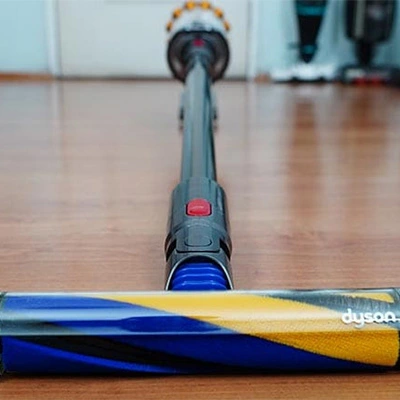
Dyson V15 Detect
Best For: homes with mixed flooring and buyers who want the strongest cleaning performance.
- Best all-around performance
- Tracks dust
- Lengthy run time
- Excellent at vacuuming long hair
- Expensive
- Hard to push on plush rugs (or thicker carpet)
- Airflow [Max at Nozzle]: 69.19 CFM
- Cleaning [Overall]: 99.91%
- Deep Cleaning: 100%
- Run Time: 84:19 mins
- Noise: 80.80 dB
- Fog Test: No Leaks
- Weight: 6.8 lbs (w/ nozzle)
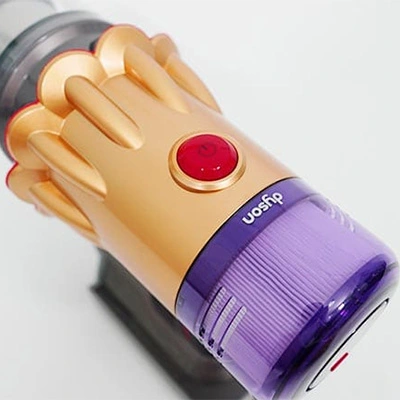
Dyson V12 Detect
Best For: buyers who want strong performance without the weight of larger models.
- Lightweight version of the V15
- Cheaper option,
- Push button switch
- Excellent all-around cleaning performance
- Tiny dustbin
- Still expensive
- Airflow [Max at Nozzle]: 48.38 CFM
- Cleaning [Overall]: 98.31%
- Deep Cleaning: 94.1%
- Run Time: 63:00 mins
- Noise: 80.7 dB
- Fog Test: No Leaks
- Weight: 5.2 lbs (w/ nozzle)
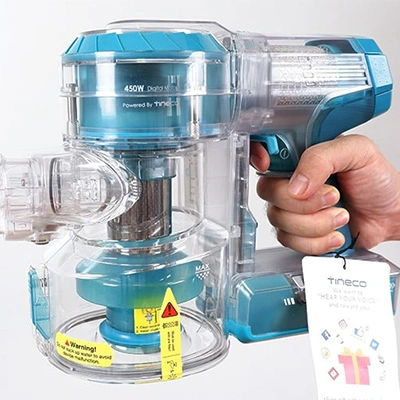
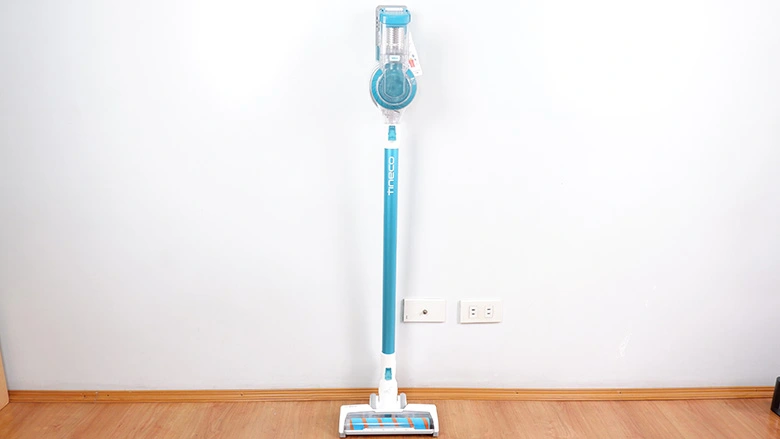
Tineco A11
Best For: buyers looking for the best balance between price and performance.
- Superb debris pick up
- Lots of tools
- Lightweight frame,
- Above-average deep cleaning
- Short run time
- Noisy
- Shallow turning radius
- Airflow [Max at Nozzle]: 39.72 CFM
- Cleaning [Overall]: 99.8%
- Deep Cleaning: 96.45%
- Run Time: 26:44 mins
- Noise: 75.4 dB
- Fog Test: Slight leaks
- Weight: 5.5 lbs (w/ nozzle)
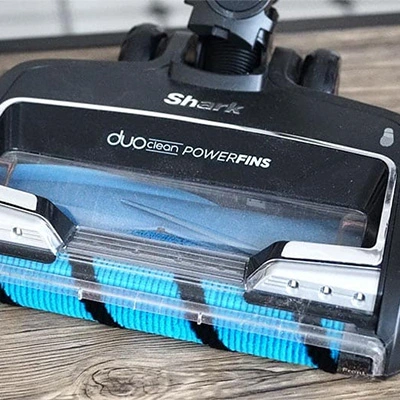
Shark Vertex Pro IZ682H
Best For: homes with mostly hard floors.
- Above-average at vacuuming long hair
- Self-standing
- Large capacity dustbin
- Detachable battery
- Excellent pick up on hard floors
- Noisy
- Below-average airflow
- A bit pricey
- Bulky nozzle
- Airflow [Max at Nozzle]: 27.76 CFM
- Cleaning [Overall]: 97.93%
- Deep Cleaning: 92.75%
- Run Time: 50:21 mins
- Noise: 89.4 dB
- Fog Test: Slight leaks
- Weight: 8.82 lbs (w/ nozzle)
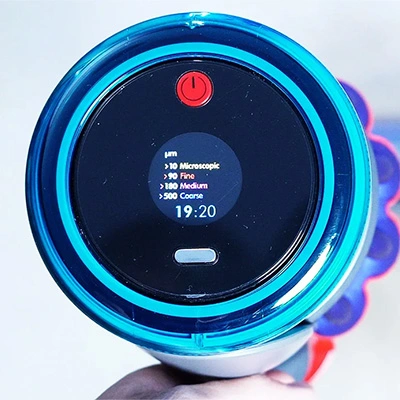
Dyson Gen5 Outsize
Best For: Large homes that generate a lot of debris and benefit from the bigger dustbin and wider cleaning head.
- Large capacity dustbin
- 12" carpet nozzle
- Select models come with two batteries
- Excellent at deep cleaning carpet
- Extremely top heavy
- High cost
- Not suitable for handheld use
- Airflow [Max at Nozzle]: 59.5 CFM
- Cleaning [Overall]: 100%
- Deep Cleaning: 100%
- Run Time: 79:50 mins
- Noise: 84.0 dB
- Fog Test: No leaks
- Weight: 8.6 lbs (w/ nozzle)
⚡ Quick Verdict
👉 Choose the Dyson V15 Detect if: you want the best balance of power, technology, and real-world performance. It delivers strong suction, excellent airflow, and top-tier cleaning on both carpet and hard floors without the bulk of larger models.
👉 Choose the Dyson V12 Detect if: you want a lighter, easier-to-handle vacuum with smart features like laser dust detection—ideal for smaller homes or daily maintenance cleaning without sacrificing too much performance.
👉 Choose the Tineco A11 if: you’re on a tighter budget but still want solid everyday cleaning performance. It’s not as powerful as Dyson models, but it gets the job done for lighter workloads and hard floors.
👉 Choose the Shark Vertex Pro if: you want a more affordable alternative with strong surface debris pickup and a flexible design. It’s a good option for mixed flooring, but not as refined in airflow or deep cleaning.
👉 Choose the Dyson Gen5 Outsize if: you want maximum power, longer runtime, and a larger bin for bigger homes. It’s the strongest performer here—but heavier, bulkier, and overkill for smaller spaces.
Bottom line: The V15 Detect hits the sweet spot for most people. The Gen5 Outsize is best for large homes and heavy-duty cleaning, while the V12 Detect is ideal if you prioritize weight and maneuverability. Budget options like the Tineco A11 and Shark Vertex Pro work—but come with clear trade-offs in power and refinement.

Some of the cordless vacuums I’ve tested. Trust me, there’s a lot more.
Why Can You Trust This
I don’t rely on manufacturer claims or marketing specs. Every cordless vacuum featured here has been tested using the same real-world methods to measure how they actually perform in a home.
Each model undergoes a series of controlled experiments designed to evaluate not just raw power but also how well it cleans across different surfaces and conditions.
Here’s what that includes:
- Airflow testing (CFM): measured at both the wand and nozzle to understand real cleaning performance
- Suction (water lift): measured at the motor to assess potential power
- Carpet deep-cleaning tests: using embedded debris like sand to simulate real-world conditions
- Hard floor pickup tests: evaluating how efficiently each vacuum handles surface debris
- Hair pickup tests: using 5-, 7-, 9-, 11-, and 12-inch strands to test performance and tangling
- Filtration testing: using a fog test to check for leaks and fine particle escape
- Runtime testing: measured across different power settings in real usage scenarios
Every test is repeated multiple times using the same equipment to ensure consistency. The results you see are based on measured performance—not opinions.
I’ve spent hundreds of hours testing cordless vacuums since 2017, and this guide reflects what actually works, what doesn’t, and where each model falls short.
Want to see how every vacuum is tested? Visit our Testing Methodology Hub
What I Learned From Testing 30+ Cordless Vacuums
After testing more than 30 cordless vacuums using airflow measurements, suction tests, deep-cleaning experiments, and hair pickup tests, a few consistent patterns emerged.
Many of the things brands emphasize—like peak suction numbers or advertised runtime—don’t always translate to better real-world cleaning.
Instead, performance often comes down to how well different components work together. These insights are based on repeated testing across different floor types, debris types, and hair lengths.
1. Airflow Matters More Than Most People Think
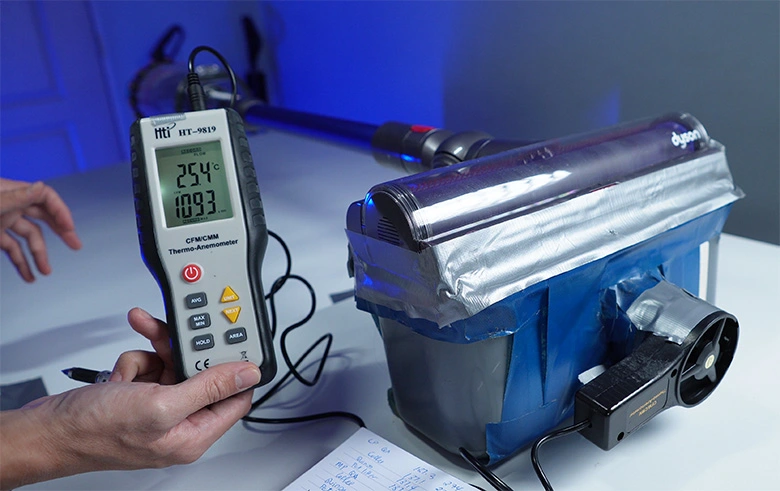
One of the biggest takeaways is that airflow plays a critical role in cleaning performance, especially on carpet. While suction is often highlighted in marketing, airflow is what actually moves debris through the cleaning head and wand and into the dustbin.
In testing, models with higher airflow consistently performed better in deep-cleaning experiments, particularly when removing embedded debris from carpet fibers.
2. Brush Design Can Make or Break Performance
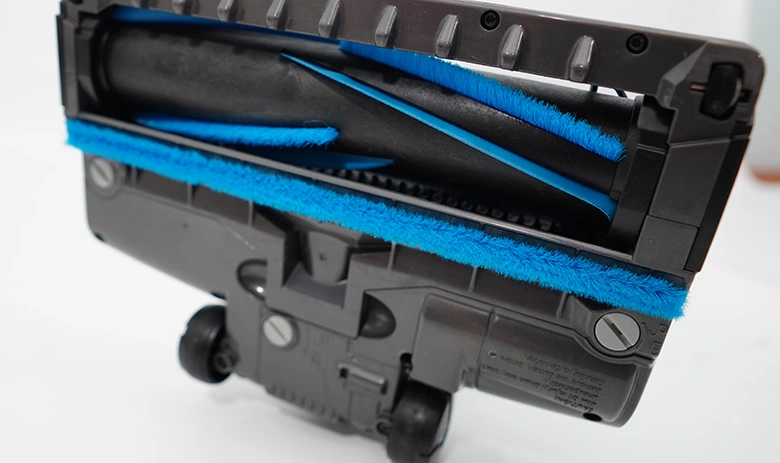
Another important factor is brush roll design, which has a major impact on both debris pickup and hair management.
Vacuums with well-designed brush rolls agitated carpet effectively and lifted debris more efficiently, while poorly designed ones struggled—even with strong suction.
This becomes even more noticeable with long hair, where some models tend to wrap hair around the brush or axles rather than transfer it into the bin.
Soft rollers also make a noticeable difference on hard floors. In testing, vacuums equipped with soft rollers were more effective at picking up fine debris like sand and dust, especially along edges and in seams between floorboards.
They also tend to reduce scatter, which is a common issue with traditional brush rolls on hard surfaces.
3. Take Advertised Run Time With A Grain Of Salt

Another thing that stood out is that real-world runtime often differs from advertised claims.
Many manufacturers list maximum runtime using non-powered tools, which doesn’t reflect actual cleaning conditions.
When tested with motorized heads on typical settings, runtime is often significantly lower—something to consider for larger homes or longer cleaning sessions.
4. Most Cheap Models Have A Fatal Flaw

One consistent issue I’ve seen across lower-cost cordless vacuums is poor sealing around the dustbin and exhaust system.
While these models claim to have good filtration on paper, weak seals allow fine dust and particles to escape back into the air instead of being fully captured.
In filtration tests, this often shows up as visible leakage—especially around the dustbin seams, filter housing, or exhaust vents.
Even if the vacuum can pick up debris effectively, poor sealing undermines overall performance by reducing efficiency and allowing particles to recirculate into the room.
This becomes more noticeable over time as filters wear down or the dustbin fills up.
Models with tighter seals and better-designed filtration systems tend to maintain consistent performance, while those with weaker sealing can suffer from reduced suction efficiency and compromised air quality.
The takeaway is that filtration isn’t just about having a HEPA filter—it’s about how well the entire system is sealed. Even a strong motor can’t compensate for a poorly sealed design.
5. The Latest Model Isn’t Always The Best

One pattern that stood out in testing is that newer models don’t always outperform their predecessors.
While newer releases often come with updated features, higher-claimed suction, or redesigned attachments, these changes don’t always translate into better real-world cleaning performance.
Case in point: the Dyson Gen5 Detect. Despite its claimed 70-minute runtime, it didn’t surpass the V15 Detect’s tested runtime of over 84 minutes with the nozzle attached. However, it did outperform the V15 in both Auto and Boost modes.
| Power Setting | Dyson V15 | Dyson Gen5 |
|---|---|---|
| Run Time on Hard Floor | ||
| Low (hh:mm:ss) | 1:24:19 | 1:20:13 |
| Mid/Auto (hh:mm:ss) | 41:30 | 46:35 |
| High (hh:mm:ss) | 13:44 | 14:44 |
| Run Time on Carpet | ||
| Low (hh:mm:ss) | 56:58 | 47:33 |
| Mid/Auto (hh:mm:ss) | 17:23 | 22:12 |
| High (hh:mm:ss) | 11:02 | 11:53 |
Nonetheless, the Dyson Gen5 Detect outperformed the V15—particularly in Auto mode, where it has its biggest advantage.
The airflow difference between the two is minimal, as shown in the cleaning tests—the V15 Detect performs nearly identically to the Gen5 Detect, with only negligible differences in results.
One advantage for consumers is that when a new model is released, prices of older models tend to drop—making them a better value despite having “older” technology.
The takeaway is that performance should be evaluated based on real-world testing, not release date or marketing claims. New doesn’t always mean better—it just means different.
6. Bin Design Matters More Than You’d Expect
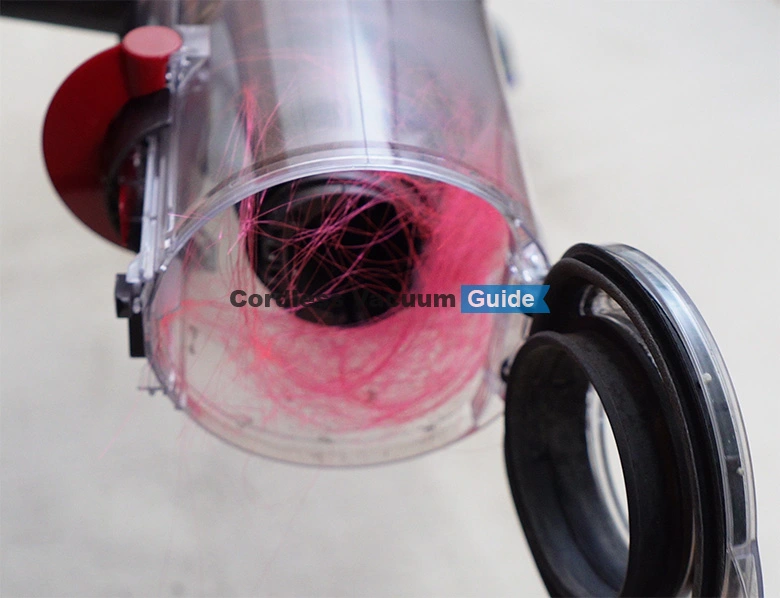
Another overlooked factor is bin design. It’s not just about how much debris a vacuum can hold, but how easily that debris can be emptied.
Narrow or poorly shaped bins tend to trap hair and dust, often requiring manual removal.
Wider bins and designs with active debris-ejection systems make the process much easier and more hygienic, particularly when dealing with hair.
7. Hair Pickup Exposes Real Weaknesses
Hair pickup tests reveal some of the most telling differences between models.
Weaker designs struggle to pick up hair, clog in the nozzle or wand, or wrap strands tightly around the brushroll and axles.
Better-performing vacuums can lift and transfer hair cleanly into the dustbin without tangling or blocking airflow, which makes a significant difference in real-world use—especially for pet owners.
8. Balance Matters More Than Weight
Lightweight models do have an advantage, but how that weight is distributed makes a bigger difference during actual use. In testing, top-heavy designs often felt awkward and fatiguing—especially during longer cleaning sessions or when using handheld mode.
By contrast, well-balanced vacuums—even if slightly heavier—tend to feel more stable, easier to control, and less tiring over time.
The takeaway: don’t judge usability by weight alone—balance is just as important.
The Best Cordless Vacuums
After testing more than 30 cordless vacuums using identical real-world methods—measuring airflow, suction, deep-cleaning performance, hair pickup, filtration, and runtime—these are the models that consistently performed the best.
Each pick below earned its place based on measurable results, not brand reputation or marketing claims.
You’ll find options for different needs, whether you prioritize carpet cleaning, hardwood floors, pet hair pickup, or overall value.
Best Overall: Dyson V15 Detect

Pros
- Flagship-level performance at a lower price tier
- Excellent surface and deep cleaning performance
- Runs for over 84 minutes with the laser slim roller
- The fully sealed system didn’t leak during the fog test
- Efficient at cleaning long hair, even on upholstery
- Green laser reveals fine dust that’s nearly invisible to the naked eye
Cons
- Hair tends to wrap around the laser slim roller axle
- Run time severely degraded at the auto setting on carpet
- Still expensive
Best Lightweight: Dyson V12 Detect

Pros
- Delivers an excellent balance of cleaning performance, runtime, and dustbin capacity
- Green laser helps reveal fine dust that’s otherwise hard to see
- Solid runtime of around 60 minutes on the lowest setting with the laser nozzle
- The detachable battery makes it easy to extend the runtime with a spare
- No trigger required, allowing for more comfortable continuous use
Cons
- Smaller dustbin requires more frequent emptying
- Hair can wrap around the laser roller axle
- Lacks an active anti-tangle system on both brush rolls
Best Value: Tineco A11
Pros
- Delivers near-premium performance on surface debris
- Strong deep-cleaning ability for a mid-range model
- Swappable battery extends overall runtime
- Noticeably quieter than comparable Dyson models
- Well-sized dustbin for its compact design
Cons
- Shorter runtime than comparable Dyson models
- Less maneuverable due to a tighter turning radius
- Filter clogs quickly, requiring more frequent maintenance
Best For Hard Floors: Shark Vertex Pro

Pros
- Delivers over 50 minutes of runtime on a single charge
- Large dustbin reduces the need for frequent emptying
- Dual brush rolls handle heavy debris without slowing down
- User-friendly handle controls improve ease of use
- Foldable wand allows for compact, vertical storage
Cons
- Falls slightly short of Dyson models in deep carpet cleaning
- Larger nozzle makes maneuvering in tight spaces more difficult
- Not as ergonomic in its handheld configuration
Best For Large Homes: Dyson Gen5 Outsize

Pros
- Best-in-class cleaning performance across surfaces
- Up to 160+ minutes of runtime with dual detachable batteries
- Laser slim roller reveals fine dust you’d otherwise miss
- Extra-large 1.89L dustbin for extended cleaning sessions
- Achieved a perfect 100% hair pickup score on mid-pile carpet
- Wide 12-inch carpet brush roll covers more area per pass
Cons
- Premium price tag compared to most competitors
- Top-heavy build limits usability in handheld mode
- Noticeably loud at all power levels
- Harder to push on carpet with gates fully closed
Best for: This model is ideal for users who need a cordless vacuum capable of handling large volumes of debris across all surfaces—even in bigger homes. Based on my testing, the Dyson Gen5 Outsize achieved perfect scores across multiple test categories, including surface debris pickup on hard floors and carpets, as well as hair pickup on carpet—something that’s rare for a cordless vacuum. It also stands out for its massive 1.89-liter dustbin, which can hold a significant amount of debris before needing to be emptied. Combined with its dual detachable batteries, total runtime exceeds 160 minutes, allowing for over two and a half hours of uninterrupted cleaning on hard floors, or more than 50 minutes on carpet using the Auto setting. If runtime and dustbin capacity are top priorities, this is one of the best cordless options available.
Performance & Spec Comparison Table
To make it easier to compare these vacuums side by side, I’ve compiled the key test results into the table below.
All data comes from the same real-world testing methods—measuring airflow, suction, cleaning performance, hair pickup, filtration, and runtime—so you’re looking at consistent, apples-to-apples results.
Use this table to quickly spot which models excel in the areas that matter most to you.
| Test | Dyson V15 | Dyson V12 | Tineco A11 | Shark Vertex Pro | Dyson Gen5 Outsize |
|---|---|---|---|---|---|
| Suction | |||||
| Unsealed (" of water lift) | 22.00 | 20.00 | 20.00 | 21.00 | 28.00 |
| Sealed (" of water lift) | 65.00 | 60.00 | 65.00 | 65.00 | 83.00 |
| Airflow [Nozzle] | |||||
| Low (CFM) | 29.98 | 24.00 | 24.35 | 19.74 | 28.52 |
| Mid/Auto (CFM) | 36.32 | 28.52 | 22.93 | 33.40 | |
| High (CFM) | 69.19 | 48.38 | 39.72 | 27.76 | 59.50 |
| Airflow [Wand] | |||||
| Low (CFM) | 34.55 | 27.43 | 31.90 | 25.48 | 33.40 |
| Mid/Auto (CFM) | 42.38 | 32.23 | 29.64 | 42.72 | |
| High (CFM) | 73.00 | 58.74 | 58.00 | 48.25 | 73.00 |
| Cleaning Test | |||||
| Overall (%) | 99.91 | 98.31 | 98.60 | 97.93 | 100.00 |
| Hard Floor (%) | 99.85 | 99.80 | 99.87 | 99.75 | 100.00 |
| Sand on Hard Floor (%) | 99.80 | 99.90 | 99.40 | 99.40 | 100.00 |
| Carpet (%) | 100.00 | 99.45 | 99.80 | 99.85 | 100.00 |
| Deep Cleaning (%) | 100.00 | 94.10 | 96.45 | 92.75 | 100.00 |
| Hair Pickup (Overall) (%) | 97.76 | 89.44 | 80.85 | 94.10 | 95.80 |
| Hair Wrap Hard Floor | |||||
| 5" strands (%) | 100.00 | 96.00 | 100.00 | 100.00 | 100.00 |
| 7" strands (%) | 100.00 | 100.00 | 100.00 | 100.00 | 66.00 |
| 9" strands (%) | 100.00 | 92.50 | 100.00 | 86.00 | 100.00 |
| 11" strands (%) | 100.00 | 98.00 | 40.00 | 98.00 | 100.00 |
| 12" strands (%) | 80.60 | 100.00 | 88.00 | 92.00 | |
| Hair Wrap Carpet | |||||
| 5" strands (%) | 100.00 | 96.00 | 95.00 | 100.00 | 100.00 |
| 7" strands (%) | 100.00 | 100.00 | 72.00 | 100.00 | 100.00 |
| 9" strands (%) | 100.00 | 92.50 | 59.00 | 89.00 | 100.00 |
| 11" strands (%) | 99.00 | 30.00 | 95.00 | 100.00 | |
| 12" strands (%) | 98.00 | 85.00 | 99.97 | ||
| Anti Tangle | |||||
| Anti Tangle | Soft Roller: No Brushroll: Yes (Combs) | No | Yes | Yes (Fins + Combs) | Soft Roller: No Brushroll: Yes (Combs) |
| Run Time [Nozzle on Hard Floor or Non-Powered Tool Only] | |||||
| Low (hh:mm:ss) | 1:24:19 | 1:03:00 | 26:44 | 50:21 | 1:19:50 |
| Mid/Auto (hh:mm:ss) | 41:30 | 37:50 | 39:40 | 45:47 | |
| High (hh:mm:ss) | 13:44 | 10:38 | 26:10 | 14:28 | |
| Run Time [Nozzle Only or Nozzle on Carpet] | |||||
| Low (hh:mm:ss) | 56:58 | 42:00 | 25:00 | 47:14 | 53:47 |
| Mid/Auto (hh:mm:ss) | 17:23 | 27:31 | 28:29 | 25:50 | |
| High (hh:mm:ss) | 11:02 | 6:25 | 10:10 | 11:18 | 12:13 |
| Claimed Run Time | |||||
| Claimed Run Time (hh:mm:ss) | 1:00:00 | 1:00:00 | 40:00 | 1:00:00 | 1:10:00 |
| Noise | |||||
| Low (dB) | 70.30 | 70.10 | 72.90 | 78.20 | 72.00 |
| Mid/Auto (dB) | 72.30 | 72.50 | 84.70 | 74.00 | |
| High (dB) | 80.80 | 80.70 | 75.40 | 89.40 | 84.00 |
| Fog Test | No Leaks | No leaks | Slight leaks | Slight leaks | No leaks |
| LED Headlights | Yes | Yes | Yes | Yes | Yes |
| Adaptive Suction | Yes | Yes | No | No | Yes |
| Soft Roller | |||||
| Soft Roller? | Yes | Yes | Yes | Yes | Yes |
| Battery | 3600 mAh | 2500 mAh | 2,000 mAh | 2350 mAh | 2500 mAh |
| Recharge (hrs) | 4.5 hrs | 3 hrs | 4 hrs | 4 hrs | 4.5 |
| Dustbin Capacity | 0.77 liters | 0.35 liters | 0.6 liters | 1.28 liters | 1.89 liters |
| Weight | 6.8 lbs | 5.2 lbs | 5.5 lbs | 8.82 lbs | 8.6 lbs |
| Warranty | 2 yrs | 2 yrs | 1 yr | 2 yrs | 2 yrs |
| Run Time 2 Long Term | |||||
| Mid/Auto (hh:mm:ss) | 19:02 | 29:35 | |||
| Run Time on Hard Floor or Non-Powered Tool Only (Long Term Review) | |||||
| Low (hh:mm:ss) | 1:20:30 | 59:40 | |||
| Mid/Auto (hh:mm:ss) | 39:18 | 35:34 | |||
| High (hh:mm:ss) | 14:08 | 6:39 | |||
| Run Time on Carpet or Nozzle Only (Long Term Review) | |||||
| Low (hh:mm:ss) | 52:40 | 46:53 | |||
| Mid/Auto (hh:mm:ss) | 19:02 | 29:35 | |||
| High (hh:mm:ss) | 11:59 | 6:15 | |||
| Airflow on Nozzle - Long Term Review | |||||
| Low (CFM) | 28.52 | 17.74 | |||
| Mid/Auto (CFM) | 34.29 | 21.77 | |||
| High (CFM) | 60.39 | 36.36 | |||
| Airflow Wand Long Term | |||||
| Low (CFM) | 34.29 | 22.58 | |||
| Mid/Auto (CFM) | 43.45 | 28.52 | |||
| High (CFM) | 74.00 | 50.71 | |||
| Sand on Hard Floor (Long Term Review) | |||||
| Sand on Hard Floor (%) | 99.80 | 99.50 | |||
| Deep Cleaning (Long Term Review) | |||||
| Deep Cleaning (%) | 100.00 | 95.00 | |||
Water Lift: Measures suction power in inches of water using a water lift gauge (+ Y-gauge). The higher the number, the stronger the vacuum’s raw suction.
CFM (Cubic Feet per Minute): Measures airflow, or how much air the vacuum moves per minute. A higher CFM generally indicates stronger suction and better cleaning performance.
dB (Decibels):: Represents the vacuum’s noise level. A lower dB value means quieter operation.
Hair Pick-Up:: The average amount of hair collected from both hard floors and carpets during tests.
Cleaning Performance: The overall average of debris (including Quaker Oats, Quinoa, Coffee Grounds, Pet Litter, and Sand) picked up across hard floors, as well as low- and mid-pile carpets.
Sand on Hard Floor: The average amount of sand removed from a bare floor surface during testing.
Fog Test: An experiment that checks the vacuum’s seal and filtration system by introducing fog into the dustbin. A properly sealed vacuum should keep the fog contained inside.
LED Headlights: Lights on the cleaning nozzle that illuminate dust and debris, making dirt easier to see in dark areas like under furniture.
👉 See how each metric is measured →
Vacuums to Avoid
Not all cordless vacuums are worth your money.
In testing, certain design flaws recurred—especially in cheaper or poorly engineered models.
These issues don’t always appear in specs or marketing materials, but they have a huge impact on real-world performance.
If you want consistent cleaning results, these are the types of vacuums I recommend avoiding.
1. Poorly Sealed Systems

One of the most common issues in lower-end models is weak sealing around the dustbin and exhaust.
In testing, these vacuums tend to lose airflow quickly and, in some cases, leak fine dust back into the air.
This not only reduces cleaning performance but can also affect air quality—especially if you’re dealing with fine particles.
Even if a vacuum claims HEPA filtration, it won’t matter if the system isn’t properly sealed.
2. Low Airflow Models
Some vacuums may advertise strong suction but still struggle with real-world cleaning due to low airflow.
This becomes especially noticeable on carpet, where debris is embedded beneath the surface. Without enough airflow, dirt doesn’t get lifted and transported effectively, leading to poor deep-cleaning performance.
In testing, these models often leave behind debris even after multiple passes.
3. Narrow or Poorly Designed Bins

Bin design is often overlooked, but it makes a big difference in usability.
Vacuums with narrow or awkwardly shaped bins tend to trap hair and debris, making them difficult to empty.
In many cases, you’ll have to reach in and pull debris out manually, which can get messy—especially with pet hair.
Wider bins or designs with better airflow pathways make debris removal much easier.
4. Nozzles That Clog Easily
Some vacuums struggle to move debris efficiently from the cleaning head into the dustbin.
In testing, this often shows up as debris getting stuck in the nozzle, partial pickup where material isn’t fully transferred, or a gradual drop in performance as small blockages build up over time.
This issue is typically caused by a combination of low airflow and narrow internal pathways, which restrict how easily debris can travel through the system.
5. Brushrolls Without Anti-Tangle Design

Hair wrap is a common issue, especially in homes with pets or long hair.
Vacuums without an effective anti-tangle system tend to accumulate hair around the brushroll or axles.

Over time, this reduces cleaning performance and requires frequent manual cleaning.
Better designs actively prevent hair from wrapping, allowing debris to move cleanly into the bin.
6. Overly Gimmicky Features With Weak Core Performance
Some models focus heavily on extra features—like lights, sensors, or app connectivity—while neglecting core cleaning performance.
In testing, these vacuums often look impressive but underperform where it matters most: actual debris pickup.
Features can be useful, but they should never come at the expense of airflow, brush design, or overall cleaning ability.
7. Not All Budget Vacuums Are Bad
It’s worth noting that not every affordable vacuum falls into these categories.
There are a few budget-friendly models that perform well because they get the fundamentals right. But many cheaper options cut corners in ways that directly affect performance.
Bottom Line
The key is knowing what to look for—and what to avoid.
After testing dozens of cordless vacuums, one thing is clear: Most poor-performing models fail for the same reasons—weak airflow, poor sealing, and flawed design.
Avoiding these common pitfalls will save you from buying a vacuum that looks good on paper but struggles in real-world use.
Buying Guide
Choosing the right cordless vacuum isn’t about picking the most expensive model—it’s about matching the vacuum to your home and cleaning needs.
After testing 30+ cordless vacuums, I found that a few key factors make a huge difference in real-world performance. Here’s what actually matters.
1. Airflow vs Suction — What Actually Matters?
Most brands highlight suction power, but that doesn’t tell the whole story.
- Suction (water lift) = how strong the pull is
- Airflow (CFM) = what actually moves debris into the bin
👉 From testing:
- High suction alone doesn’t guarantee good cleaning
- Airflow is critical—especially on carpet
Bottom line: If you’re cleaning carpet, prioritize models with strong airflow—not just high suction claims.
2. Your Floor Type Changes Everything
Not all vacuums perform the same on different surfaces.
For Carpet:
- Needs strong airflow + agitation
- Brushroll design matters a lot
- Poor airflow = weak deep cleaning
For Hardwood Floors:
- Soft rollers work best
- Less risk of scratching
- Easier debris pickup
👉 If your home has both: Look for models with interchangeable heads or adjustable settings.
3. Pet Hair: The Hidden Challenge
Pet hair exposes weaknesses fast.
From testing:
- Hair gets stuck in narrow bins
- Wraps around brushrolls without an anti-tangle design
- Low airflow models struggle to move hair into the bin
What to look for:
- Anti-tangle brushroll
- Wide bin design
- Strong airflow
4. Battery Life (Real vs Claimed)
Manufacturers often advertise max runtime, but that’s misleading.
👉 In real-world use:
- Auto or medium settings matter more
- Boost mode drains the battery quickly
- Some vacuums last longer than others despite lower claims
Pro tip:
Look for models with:
- Replaceable batteries
- Consistent runtime in mid-power mode
5. Dustbin Design (Underrated but Important)
This is one of the most overlooked factors.
From testing:
- Narrow bins clog easily
- Hair sticks to plastic surfaces
- Emptying can be messy
Better designs:
- Wider bins
- Straight airflow paths
- Mechanisms that push debris out (like Dyson)
6. Brushroll Design & Hair Wrap
Hair wrap is a real problem—especially with long strands.
From testing:
- Some vacuums wrap hair around axles or brushes
- Others struggle with picking up stands on carpets
Look for:
- Anti-tangle systems
- Minimal gaps around the brush
- Efficient agitation without wrapping
7. Noise, Weight, and Ease of Use
These don’t affect cleaning performance—but they affect daily use.
Consider:
- Weight (especially for stairs and above-floor cleaning)
- Maneuverability
- Noise levels
👉 A powerful vacuum isn’t useful if it’s uncomfortable to use regularly.
Common Mistakes to Avoid
After testing dozens of vacuums, these are the biggest traps:
- ❌ Choosing based on suction numbers alone
- ❌ Assuming newer models are always better
- ❌ Ignoring airflow and brush design
- ❌ Buying cheap models with poor seals
- ❌ Overlooking bin design and maintenance
Final Advice
If you’re unsure, focus on this:
- Carpet → prioritize airflow + brushroll design
- Hardwood → prioritize soft rollers
- Pets → prioritize anti-tangle + bin design
- Mixed home → go for versatility
👉 The best cordless vacuum isn’t the most expensive—it’s the one that fits your specific needs.
FAQ Section
1. What is the best cordless vacuum overall?
Based on my testing, the best cordless vacuum overall is the Dyson V15 Detect.
It’s not the newest model, but it delivers the best overall balance of high airflow, consistent cleaning performance on both hard floors and carpets, strong deep-cleaning ability, and above-average hair pickup—all without the higher price of newer flagship models like the Dyson Gen5 Detect.
That said, if you need longer runtime or a larger dustbin for bigger homes, newer options like the Dyson Gen5 Outsize may be worth considering.
2. What should I look for in a cordless vacuum?
The most important factors are:
- Airflow (CFM): Critical for carpet cleaning and moving debris into the bin.
- Brush design: Determines how well it agitates debris.
- Run time: Important for cleaning larger areas.
- Battery detachability: If you want to extend the runtime.
- Dustbin design: Affects how easily debris (especially hair) is emptied.
- Dustbin seal: Determines whether dust and debris stay inside.
From testing, airflow and brush design tend to have the biggest impact on real-world performance—not just suction alone.
3. Are Dyson cordless vacuums worth it?
In most cases, yes—but it depends on your needs.
Dyson models consistently perform well in testing, particularly in carpet deep cleaning, surface debris pickup, and filtration.
However, they are expensive, and not every model offers the best value. Some older models (like the V12 or V15) can be better deals when discounted.
Another reason to consider Dyson is the wide availability of spare parts—even for older models. You can easily find replacements for everything from filters to motors, which makes long-term maintenance much more manageable.
4. Which cordless vacuum is best for pet hair?
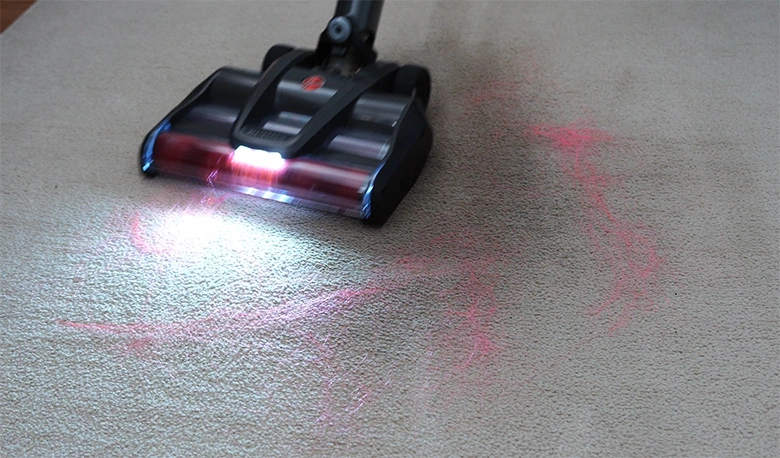
The best cordless vacuums for pet hair combine strong airflow, effective anti-tangle brush designs, and hair-resistant brushes. These features allow the vacuum to pick up hair efficiently while minimizing buildup on the brush roll.
Models like the Dyson V15 Detect and Shark Vertex Pro stand out because they can handle long hair without excessive tangling and move it efficiently through the system into the dustbin.
5. Are cordless vacuums good for carpet?

Yes, but not all cordless vacuums perform well on carpet.
Effective carpet cleaning requires strong airflow, proper brush agitation, and a good seal with the floor. These factors work together to lift debris embedded deep within carpet fibers.
In testing, only higher-performing models consistently removed embedded debris such as sand.
Cheaper models—especially those with weaker airflow or less effective brush designs—tend to struggle with deep cleaning and often leave debris behind.
6. How long should a cordless vacuum last?
Most cordless vacuums last around 3 to 5 years, depending on usage and overall build quality. In my experience, some Dyson models like the Dyson V12 Detect Slim and Dyson V15 Detect are still running well after more than five years of use.
In most cases, battery performance is the first component to degrade. Higher-end models tend to last longer thanks to features like detachable batteries, better build quality, and more reliable seals and internal components.
Proper maintenance also plays a major role. Regularly cleaning filters, emptying the dustbin, and preventing clogs can significantly extend the lifespan of a cordless vacuum.
7. Why do some cordless vacuums lose suction over time?
Loss of performance is usually caused by a combination of factors, including clogged filters, blockages in the wand or nozzle, poor sealing around the dustbin, and battery degradation.
Over time, these issues can reduce airflow and overall efficiency, leading to weaker suction and inconsistent cleaning performance.
8. Is a more expensive cordless vacuum always better?
No—and this is a big misconception.
Newer or more expensive models don’t always outperform older ones. In some cases, improvements are incremental, and the performance difference is small.
That’s why real-world testing matters—some older models offer better value with nearly identical cleaning performance.
9. What is the best cordless vacuum for hardwood floors?
The best cordless vacuums for hardwood floors typically use soft roller brush heads. These are designed to pick up fine dust, prevent scratching, and handle larger debris more efficiently. Models like Dyson’s soft roller variants perform especially well on this surface.
👉 Still not sure? Scroll back up to see my top picks based on your needs.